HESPERIA, CALIF., June 6 (Our Hesperia)
A performance metric from the translation company Translated suggests artificial intelligence translation could approach human-level quality by the end of the decade, while other forecasts remain widely split.
The Rome-based company tracked its AI translation system from 2014 to 2022 using a measure called “Time to Edit,” or TTE, according to Popular Mechanics. The metric measures how long professional human editors take to correct AI-generated translations compared with translations written by people.
Translated analyzed more than 2 billion post-edits over the eight-year period. The company’s data showed that human translators take about one second per word to edit another human translator’s work.
For machine-generated translation, professional editors took about 3.5 seconds per word in 2015, Popular Mechanics reported. At the time of the report, that figure was about two seconds per word.
If that trend continues, Translated’s AI translation system could reach human-level translation quality by the end of the decade or sooner, according to Popular Mechanics. That would not prove the broader technological singularity has arrived, but it would mark a concrete AI capability reaching a human benchmark in one field.
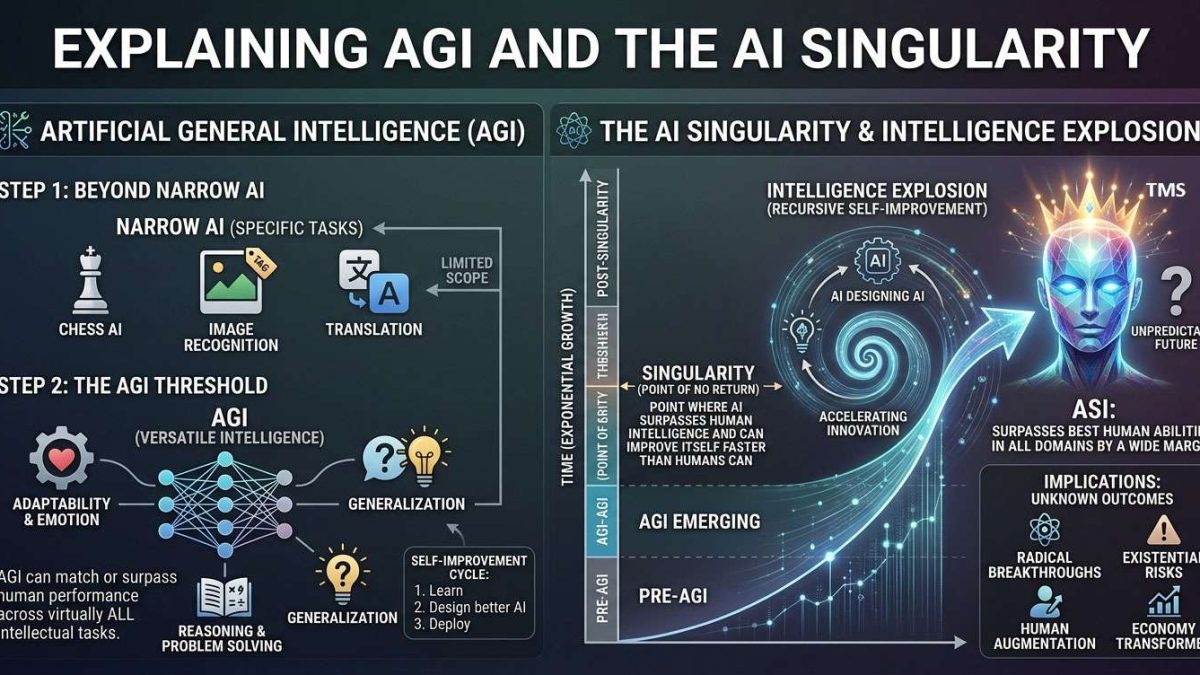
Popular Mechanics has described the technological singularity as the concept of artificial intelligence moving beyond human control and rapidly transforming society.
The forecast is one of several competing timelines for advanced AI. Ray Kurzweil, described by Popular Mechanics as an American computer scientist and futurist, has long predicted human-level AI around 2029 and a singularity around 2045.
Kurzweil reaffirmed a five-year prediction in a TED Talk and has predicted a “millionfold” expansion of intelligence by 2045 through brain interfaces involving nanobots.
Other predictions have missed or varied widely. Wikipedia’s summary of the technological singularity lists I.J. Good’s 1965 view that an ultra-intelligent machine was more probable than not in the 20th century, Hans Moravec’s 1988 prediction that supercomputer capability for human-level AI would be available before 2010, and Vernor Vinge’s 1993 forecast of greater-than-human intelligence between 2005 and 2030.
Wikipedia also summarizes informal polls of AI researchers conducted in 2012 and 2013 by Nick Bostrom and Vincent C. Müller that produced a 50% median confidence that human-level AI would be developed between 2040 and 2050.
More recent online forecasts continue to diverge. ETC Journal posts dated October and December 2025 described their estimates as “guesstimates” and generally placed the singularity in the 2030s or 2040s, while noting more aggressive forecasts around 2026 to 2029.
An ISPCR post dated Jan. 11, 2026, made a stronger claim, saying “we have crossed the threshold of the Singularity” and estimating an effective onset between October 2025 and January 2026. The post cited emergent behavior in GPT-class models, semi-autonomous tool use by multimodal agents and adoption in software development, legal reasoning and early scientific hypothesis generation.
For Hesperia residents, schools and businesses using AI tools, the Translated metric points to a narrower near-term development: AI translation still required more human editing time than human translation in the reported data, but the gap had narrowed substantially by the end of the tracking period.