
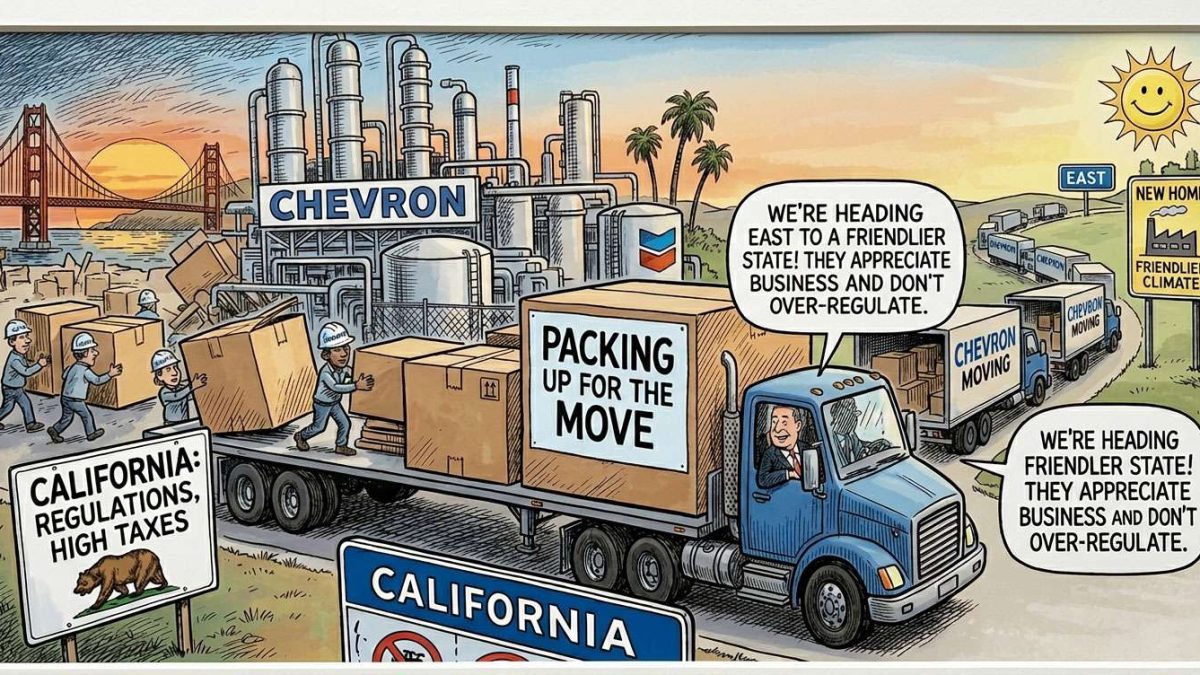
Chevron warns “fuel crisis” risk in California — says tight climate rules and Iran war could force refineries to close in 10 years
Chevron’s refining president warns California faces a severe fuel crisis and possible refinery exit within 10 years, citing strict environmental rules and global supply disruptions tied to the Iran war that could force Chevron to stop refining in-state.
Key takeaways
- Chevron warns it “won’t be able to make it” in California within a decade unless rules and taxes change, risking widespread fuel shortages.
- Two main drivers: global supply shocks tied to the Iran conflict and higher local costs from recent California air and Cap‑and‑Invest rules.
- State impact: Chevron’s refineries represent roughly a third of California’s refining capacity; closures could immediately tighten supplies in an energy‑island state.
- Local consequences: Communities such as Hesperia could see higher fuel costs, operational strains on logistics and public services, and political pressure on Sacramento.
Key information and company warnings
Andy Walz, head of Chevron’s refining operations, told state leaders the company may not be able to continue refining in California unless rules and taxes are changed. Walz said Chevron “won’t be able to make it” and predicted the company could be gone from the state in 10 years if conditions do not improve. Reporting appeared in Energy News Beat and BIC Magazine.
How Chevron frames the threat
Walz linked the threat to two forces: a global supply shock tied to fighting around the Strait of Hormuz and California policies that raise costs for refineries, including changes to Cap‑and‑Invest and other air rules. Company messages say the global squeeze — reduced product flows from Asian refining hubs — and higher local costs make operating in California “increasingly unsustainable.” Trade reporting summarized these concerns; see Energy News Beat and BIC Magazine.
“Adversarial policies at local, regional and state levels have eroded that foundation,” Chevron warned, saying proposed regulatory changes “threaten to destroy it.”
The global supply picture
Industry reports cited by Chevron estimate disruptions related to the Iran conflict have reduced global refinery runs by roughly 2.8 million barrels per day — about 3–4% of worldwide capacity — removing both crude supply and refined fuels from markets. Major Asian refining centers have been affected and some countries have limited exports, slowing shipments California relies on to top up local inventories. See reporting in Energy News Beat and BIC Magazine.
California’s structural vulnerabilities
California has lost most of its mid‑20th century refining footprint: from roughly 40 refineries decades ago to seven today. Several remaining operators have signaled plans to cut runs or exit, leaving the state exposed to any single operator’s move. Industry observers call California an “energy island” because pipeline links to the rest of the U.S. are limited; the state must refine most gasoline and diesel used locally. Energy data from the California Energy Commission is cited by analysts.
Import reliance and trade angles
Although California refines a large share of its gasoline locally, the state also relies on imports of crude and refined product — especially from Asian markets such as China, South Korea and Singapore. Those supplies can tighten quickly when export bans or cutbacks occur. Chevron and others warn that a high share of crude sourced outside the U.S. is a “dangerous game” for state energy security. See Energy News Beat reporting for details.
Economic and national‑security warnings from industry
Industry groups say refinery closures would ripple through California’s economy: diesel for agriculture and freight, jet fuel for airlines and the military, and gasoline for commuters could all be affected. Some commentators urge federal intervention to treat downstream fuel infrastructure as critical, including temporary pause authorities or regulatory reviews to ensure continuity of supplies. These ideas appear in trade reporting tied to Chevron’s warnings; see Energy News Beat.
What regulators and critics say
California regulators and policy supporters argue environmental rules protect public health, reduce pollution, and accelerate alternatives to oil. Programs like Cap‑and‑Invest and the Low Carbon Fuel Standard are framed as long‑term transitions. Chevron counters that the pace and cost of change risks driving refiners out before replacements are ready; excerpts of Chevron’s letter criticizing tighter caps and compliance burdens were reported by MarketScreener.
Calls for federal and state action
Industry voices urge quick action: suspend or soften rules that raise refinery costs, reconsider tax structures that target refineries, and treat refineries as strategic assets. Some advocates request federal authority to ensure continuity of fuel supplies amid international shocks. Those proposals are advanced in opinion pieces and advocacy statements tied to the current warnings; see reporting by Energy News Beat.
Implications for Hesperia, California
Economic impact
Hesperia, in San Bernardino County, relies on steady fuel supplies for freight, trucking, nearby agriculture and commuting. A statewide shortage or price spike would raise costs for businesses and households; higher diesel prices would increase delivery and freight costs, pushing up local prices. Reduced state refining capacity could force temporary rationing or expensive imports affecting Hesperia pump prices (see California Energy Commission and reporting at Energy News Beat).
Political consequences
Local conservative leaders and voters in Hesperia emphasize economic stability and low taxes; Chevron’s warnings could become a rallying point to pressure state lawmakers to pause or amend rules seen as driving refiners away. County supervisors and state legislators may face constituent demands for regulatory relief or federal assistance to protect energy security (see BIC Magazine).
Social effects
Rising fuel prices would strain household budgets in Hesperia, where many commute long distances. Public services dependent on diesel — fire engines, school buses, delivery fleets — could face higher operating costs. A prolonged shortage could change travel behavior, increase transportation costs for families, and force local governments to adjust budgets or services.
Practical applications for residents
Residents and businesses should monitor fuel price trends and inventory alerts, conserve fuel where possible, consider fuel‑efficient or alternative‑fuel options for key vehicles, and engage local officials to coordinate contingency plans. Industry sources urge policymakers to treat refineries and fuel logistics as essential infrastructure to avoid sudden outages (see Energy News Beat).
Reporting notes and sources
This article draws on reporting of Chevron’s warnings and industry analysis from Energy News Beat, trade publications such as BIC Magazine, and excerpts reported by MarketScreener. State energy data referenced is available from the California Energy Commission.


