
Internal Dispatches Show Chicago Patrol Chief Told Officers Not to Aid Federal Agents as Vehicles Were Rammed, Rank‑and‑File Officers Blast Decision
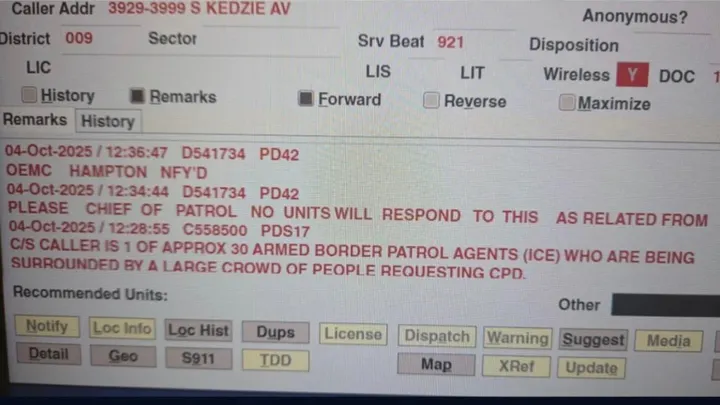
Internal dispatches obtained by Times Media Service show a Chicago patrol chief ordered officers not to assist federal agents during a violent October 4 Brighton Park operation, sparking fury among rank-and-file officers and renewed scrutiny of inter-agency cooperation.
- Dispatch recordings indicate Chicago officers were ordered not to help federal teams while agents were surrounded and vehicles were struck — captured on video and eyewitness footage (Video and eyewitness footage of the Brighton Park confrontation).
- Federal teams involved included U.S. Border Patrol and ICE agents conducting arrests tied to a separate shooting and hospitalization; protesters accused agents of excessive force (Additional video documentation and reporting).
- Rank-and-file backlash: multiple officers reacted with anger and said leadership’s order undermined police solidarity and officer safety.
What happened in Brighton Park
On the afternoon of Oct. 4, federal immigration agents conducted an operation on Chicago’s southwest side that escalated into chaotic confrontations. At one point a woman was reportedly shot and taken to the hospital after being struck during the encounter; federal officials say the incident involved a threat to officers. Images and videos show crowds confronting agents and vehicles amid a volatile scene.
Eyewitness recordings and multiple clips show agents’ vehicles being hit and personnel physically surrounded by bystanders and protesters. Those on video can be heard accusing agents of using pepper spray and less‑lethal rounds; the recordings are now central to internal and public scrutiny (Video and eyewitness footage of the Brighton Park confrontation).
Federal agents surrounded, vehicles rammed
Footage reviewed by Times Media Service shows lines of federal agents near vehicles when crowds surged. Some clips depict at least one vehicle struck from behind while agents were pushed back toward their cars. Sources at the scene described agents trapped and temporarily unable to leave without risking further confrontation — images federal officials say put agents in immediate danger (Video and eyewitness footage of the Brighton Park confrontation).
Chicago police non-intervention and internal criticism
Internal dispatch recordings include a directive from a Chicago patrol chief telling officers not to provide assistance to the federal teams. That order prompted sharp criticism from officers on the street, who said they were left watching federal colleagues face violence. One source used explicit language to describe feeling abandoned, repeating a sentiment that leadership had told them not to “cover their a‑‑.”
Rank-and-file reaction: multiple officers told Times Media Service they were furious that the department would leave other law‑enforcement personnel exposed. One anonymous officer said the episode undermined morale and trust between supervisors and street officers; another described the order as politically driven rather than safety driven.
Federal and local friction
The Brighton Park clash came amid heightened political fights over federal operations in major cities. Federal officials had increased operations in Chicago in recent weeks, prompting local pushback from city and state leaders who called the moves provocative. The prior controversial deployment of National Guard troops to Chicago added fuel to the debate, which authorities and advocates cast as politically charged and consequential for public safety (Additional video documentation and reporting).
Calls for investigations and public scrutiny
Community activists and civil‑rights groups have demanded full investigations into both the federal operation and Chicago Police Department actions. Protesters argue that intensive federal immigration raids and aggressive tactics inflame communities rather than improve safety. Simultaneously, police sources are calling for inquiry into the internal directive that kept Chicago officers from aiding federal agents who were in immediate danger.
Legal and policy analysts said mutual‑aid protocols and inter‑agency support policies will come under scrutiny as investigators attempt to reconstruct who issued orders and why.
Official response and unanswered questions
At the time of reporting, Chicago Police Department leadership had not issued a public statement directly addressing the internal dispatches or the refusal to assist federal agents. City officials acknowledged the incident and said they will review communications; federal agencies confirmed their agents were attacked and said they will cooperate with investigations. Many questions remain about the chain of command and whether policy or politics drove the non‑intervention order (Video and eyewitness footage of the Brighton Park confrontation, Additional video documentation and reporting).
Why officers are angry
Officers described a culture where backing fellow law‑enforcement personnel is a core value. The refusal to provide immediate assistance during an attack felt to many like a breach of that value. Beyond emotion, officers warn of legal and tactical implications — delayed mutual aid can increase risk to civilians and officers and could hamper prosecutions if evidence is lost or witnesses disperse.
The political dimension
For conservative readers concerned about law and order, the episode raises tough questions about priorities in city leadership. When local decisions appear to distance police from federal partners conducting lawful operations, critics say the potential for violence increases. Many demand accountability for any orders that put agents or residents at risk.
Implications for Hesperia, California
Economic impact: Hesperia businesses and residents follow national headlines because perceptions of disorder in major cities can affect tourism, property markets, and investor confidence.
Political consequences: Local conservative leaders may use the Brighton Park confrontation to argue for stronger support for law enforcement, clearer mutual‑aid agreements, and policies limiting political interference in policing.
Social effects: Residents who prioritize public safety may press for tougher crime‑fighting tools and more backup for officers; the story could intensify local debates about immigration enforcement and community policing.
Cultural relevance & practical steps: The incident may resonate with Hesperia’s conservative community as an example of perceived misplaced priorities in urban governance. Local officials may review mutual‑aid agreements, cross‑agency communications, and training to prevent similar standoffs.
What’s next
Investigations by multiple agencies are expected. Internal reviews will likely examine dispatch recordings, orders given, and timing of any help requests. Legal teams will evaluate whether department policies were followed and if disciplinary action is warranted. Videos from the scene will continue to shape public opinion.
Sources and evidence
- Video and eyewitness footage of the Brighton Park confrontation
- Additional video documentation and reporting on federal‑local tensions and related hospitalizations
No official comment: Chicago Police Department leadership had not issued a direct public statement addressing the internal directive at the time of publication. The story will be updated as departments release statements and investigations proceed.


