
Trump 50-year mortgage proposal draws praise and warnings as experts weigh mortgage implications
Donald Trump has proposed a government-backed 50-year mortgage to lower monthly payments and expand homeownership for younger buyers, a move praised by some officials but criticized by experts who warn of higher lifetime costs and slower equity buildup.
- Proposal: Federal push to allow 50-year fixed-rate mortgages backed by government-sponsored entities as a tool to lower monthly payments and broaden access to ownership.
- Support: FHFA Director Bill Pulte has called longer-term options a possible “game changer” for younger buyers (Fortune).
- Warnings: Analysts caution the loans raise cumulative interest, slow equity growth and could push prices higher by increasing buyer demand (CBS News; Politico).
How a Trump 50-year mortgage would work
Mechanics: A 50-year mortgage spreads repayment of principal and interest across five decades instead of the traditional 30 years, which lowers monthly principal-and-interest payments for the same loan amount because payments are stretched out.
Proponents argue the smaller monthly bill could let more young families buy homes now despite high prices and elevated rates (LiveNOWFox; Fox Business).
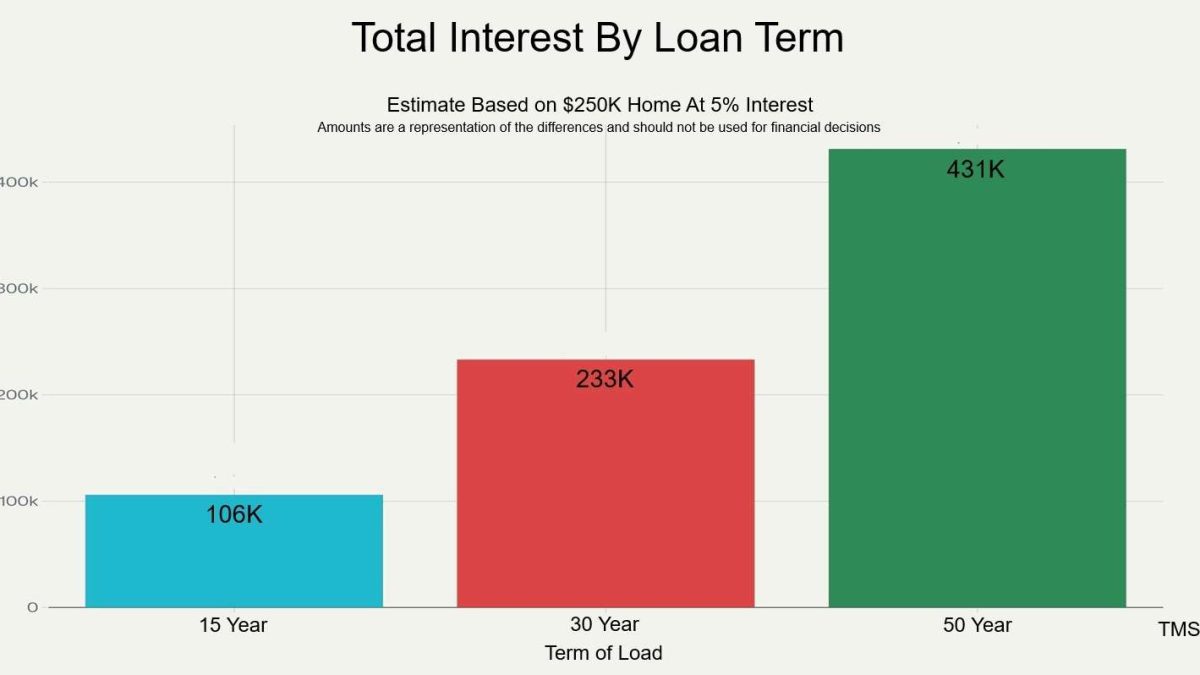
Trade-offs: The math creates clear trade-offs: the longer the term, the more total interest paid. Analysts note monthly payments fall but lifetime cost rises substantially — buyers can pay far more over 50 years than with a 30-year mortgage (Fortune).
Mortgage implications for buyers and the market
Financial advisers and housing economists highlight several implications:
- Greater cumulative interest: A 50-year loan typically results in much higher total interest payments than 30- or 40-year loans — homeowners pay more over time even as monthly bills appear smaller (Fox Business; CBS News).
- Slower equity buildup: Early payments on long-term loans mostly cover interest. Buyers on a 50-year plan would build equity slowly, leaving them more exposed to market swings and limiting refinancing or sale options (Fortune).
- Potential for higher home prices: By lowering monthly payments, longer loans can expand purchasing power—if supply doesn’t keep pace, prices may rise and erode affordability gains (Fox Business).
- Systemic and borrower risks: Critics warn a longer debt horizon could trap homeowners “in debt for a lifetime,” increase negative-equity risk in downturns, and add interest-rate and credit risks to the housing finance system (Fortune; Politico).
What analysts and policymakers are saying
Supporters say the option helps first-time buyers and households priced out by high rates, arguing the policy could be practical when paired with supply-boosting measures (HousingWire).
Critics call it a short-term Band‑Aid that avoids the root problem — too few homes for sale — and urge zoning reform, construction incentives and supply-side fixes instead (Politico).
Market-watchers also note current context: mortgage rates above 6% and many homeowners “rate-locked” into low mortgages who aren’t moving, which reduces supply and complicates affordability fixes focused only on loan terms (Fortune).
Comparative example: monthly payment vs. total cost
Using a Fannie Mae calculator cited by Fortune, for a $400,000 home with 20% down at a 6.575% interest rate:
- 30-year fixed: monthly P&I = $2,788
- 40-year fixed: monthly P&I = $2,640
- 50-year fixed: monthly P&I = $2,572
Takeaway: Monthly savings from 50 years are modest versus 30 years, while total interest over the loan’s life climbs substantially — lower monthly pain, higher lifetime cost (CBS News).
Policy trade-offs and fiscal concern
For fiscally conservative observers, the proposal raises questions about taxpayer exposure and long-term housing finance risk. If government-backed entities broaden loan types without strict underwriting, taxpayers could face larger losses in a downturn (HousingWire).
Experts urge: any new mortgage option be paired with tighter borrower protections and supply-side reforms rather than loosening loan terms alone (Politico).
Implications for Hesperia, California
Hesperia, in the high desert of San Bernardino County, has rising prices and many working families seeking affordable housing. The 50-year mortgage could affect residents in several ways:
- Home affordability: Lower monthly payments might help some local buyers qualify now, but long-term payments would be much higher — a serious consideration for buyers on fixed or modest incomes (Fox Business).
- Local prices and demand: If longer loans increase purchasing power across the Inland Empire, demand for Hesperia homes could rise and push prices up, eroding short-term benefits.
- Equity and mobility: Slow equity buildup matters in a region with frequent job shifts; sellers who move within a few years may have little equity or face negative equity (Fortune).
- Taxpayer and local government exposure: Counties and state housing programs monitor federal mortgage rule changes; higher systemic risk could raise local stabilization costs and prompt conservative policymakers to press for zoning and construction incentives (HousingWire).
- Practical choices for buyers: Local lenders, brokers and counselors must explain trade-offs clearly. For many, conservative planning favors shorter terms and faster equity — those tempted by lower monthly payments should weigh higher lifetime interest and reduced flexibility (CBS News).
Reporting and sources
This article draws on coverage and analysis from multiple outlets:
Note: Sources cited above informed the analysis, which preserves the original facts, figures and reporting links used in coverage of the proposal.


