
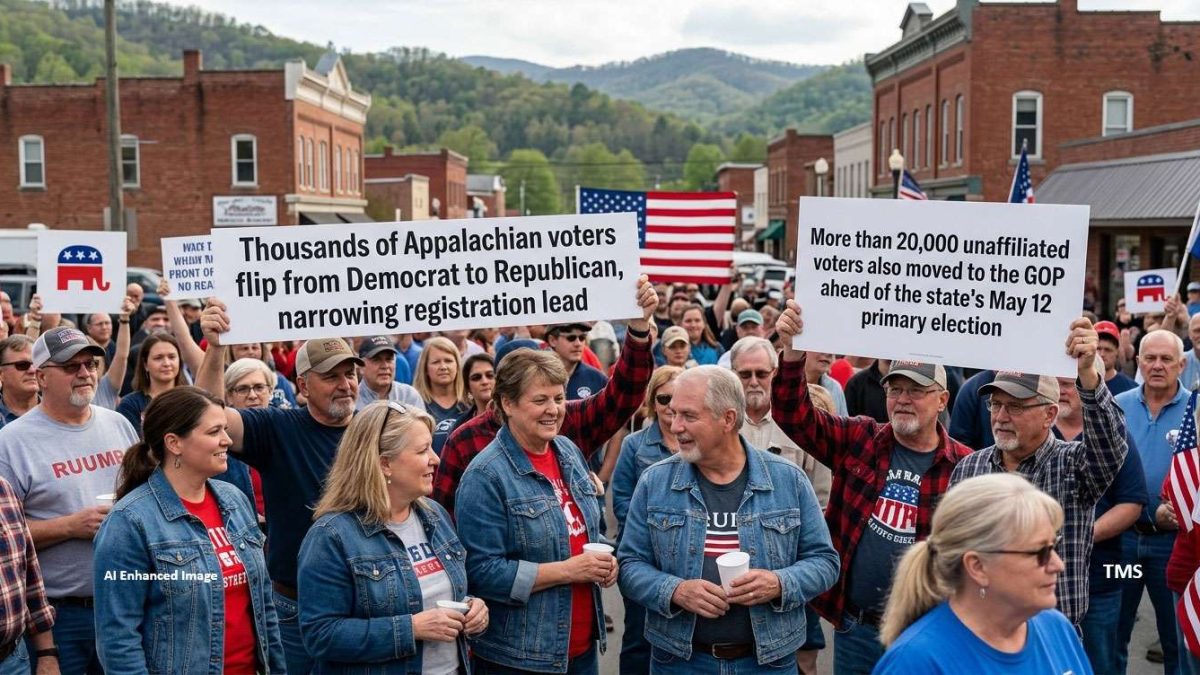
Wave of party switching in West Virginia reshapes voter rolls ahead of May 12 primary
West Virginia (Our Hesperia) – West Virginia saw a surge of party switching before the May 12 primary: 68,235 voters changed affiliations since Jan. 31, 2024, shifting thousands from Democrats and unaffiliated rolls into the Republican Party and altering the state’s electorate.
- 68,235 voters changed party affiliation since Jan. 31, 2024, per official tallies.
- Major flows to GOP: 16,910 Democrats and 20,003 unaffiliated voters moved to Republican registration.
- Rising independents: Large numbers left both parties for unaffiliated status, complicating net-party trends.
- Registration totals (April 23): 519,756 Republicans; 327,089 Democrats; 301,933 independents — Democrats + independents still outnumber Republicans by ~100,000.
What the data shows
Secretary of State Kris Warner reported that 68,235 voters changed party affiliation between Jan. 31 and late April. That raw total represents a meaningful slice of West Virginia’s electorate heading into the May 12 primary and documents a dramatic reshuffling in under three months. Fox News coverage of the secretary of state’s data provides the public tally and breakdown.
How the shifts break down
The secretary of state’s detailed numbers list the biggest moves since Jan. 31 as:
- Democrat → Republican: 16,910
- Unaffiliated → Republican: 20,003
- Democrat → Unaffiliated: 12,299
- Republican → Unaffiliated: 7,559
- Unaffiliated → Democrat: 5,211
- Republican → Democrat: 2,399
Interpretation: the figures show a net gain for the GOP in registrations but also a substantial increase in voters rejecting party labels, creating a mixed — not purely one-way — realignment.
Why voters are switching
Local Republican leaders say the changes are partially tactical: a closed primary forces voters to be registered with a party to participate. Delegate Josh Holstein, chairman of the state Republican Party, told local outlets that the closed primary structure likely encouraged registrations to the GOP so voters could take part in a competitive Republican primary.
“This huge uptick in the last couple of months is certainly tied to the primary being closed,” Holstein said. “So I think it’s why a lot of those folks said, ‘Hey, I’ll just register Republican.'”
Democratic officials caution the pattern is more complex. Delegate Mike Pushkin, state Democratic chair, said the data points to broad reshuffling rather than a simple flip and emphasized the notable flow of voters toward unaffiliated status and some movement back toward Democrats.
Closed primaries, political strategy and timing
West Virginia’s closed primary rules matter here. Because only registered party members may vote in a closed primary, voters wanting to choose among Republican contenders had a short-term incentive to register GOP. Early in-person voting was scheduled to begin April 29 and run through May 9, narrowing the window for registration changes that would still allow participation in the May 12 primary.
Party leaders also discussed longer-term changes: the West Virginia GOP voted during a winter meeting to close primaries to non-Republicans beginning in 2026 (the measure passed internally 65–54 after amendments), signaling a push to solidify primary membership going forward. See the West Virginia GOP winter meeting coverage (video) for details of that discussion.
What this means for the May 12 primary
Immediate effect: a reshaped primary electorate. With roughly 519,756 registered Republicans (April 23 totals), the GOP holds a strong base for the primary, but Democrats and independents combined (~629,022) still outnumber Republicans by about 100,000 — an important reminder that general-election dynamics remain competitive.
For campaigns, the closed rules make newly registered voters and recent switchers high-priority targets for outreach in the short term.
Voter registration changes and broader trends
This wave reflects larger patterns in Appalachian and rural America where party affiliation has been fluid. Drivers include economic concerns, cultural issues and national politics; the surge in unaffiliated voters also complicates turnout modeling and campaign targeting going forward.
Implications for Hesperia, California
Economic impact: Direct local economic effects in Hesperia are minimal because the changes are specific to West Virginia. Still, the strategic party-switching example may influence how Hesperia campaigns time registration drives and early-voting outreach.
Political consequences: California’s top-two primary system differs from West Virginia’s closed system, so wholesale translation is unlikely. Nevertheless, the West Virginia example shows how rules shape strategy; local groups should monitor registration rolls and be prepared for rapid outreach if rules change.
Practical applications for Hesperia campaigns and voters:
- Track registration data closely in San Bernardino County.
- Plan early-voting and absentee ballot drives timed to registration and participation windows.
- Educate voters on the differences between California’s primary rules and closed primaries elsewhere.
- Target unaffiliated voters with tailored messaging in general-election planning.
- Prepare rapid-response registration and education campaigns if primary rules become a focus of reform efforts.
Reporting and verification
The numeric summaries above come from West Virginia Secretary of State Kris Warner’s public data and subsequent media reporting. The tally and registration totals were published after review of the official data; media coverage and the secretary of state’s release are the primary sources for these figures.
Sources and further reading
Primary reporting and public data referenced here include:


